
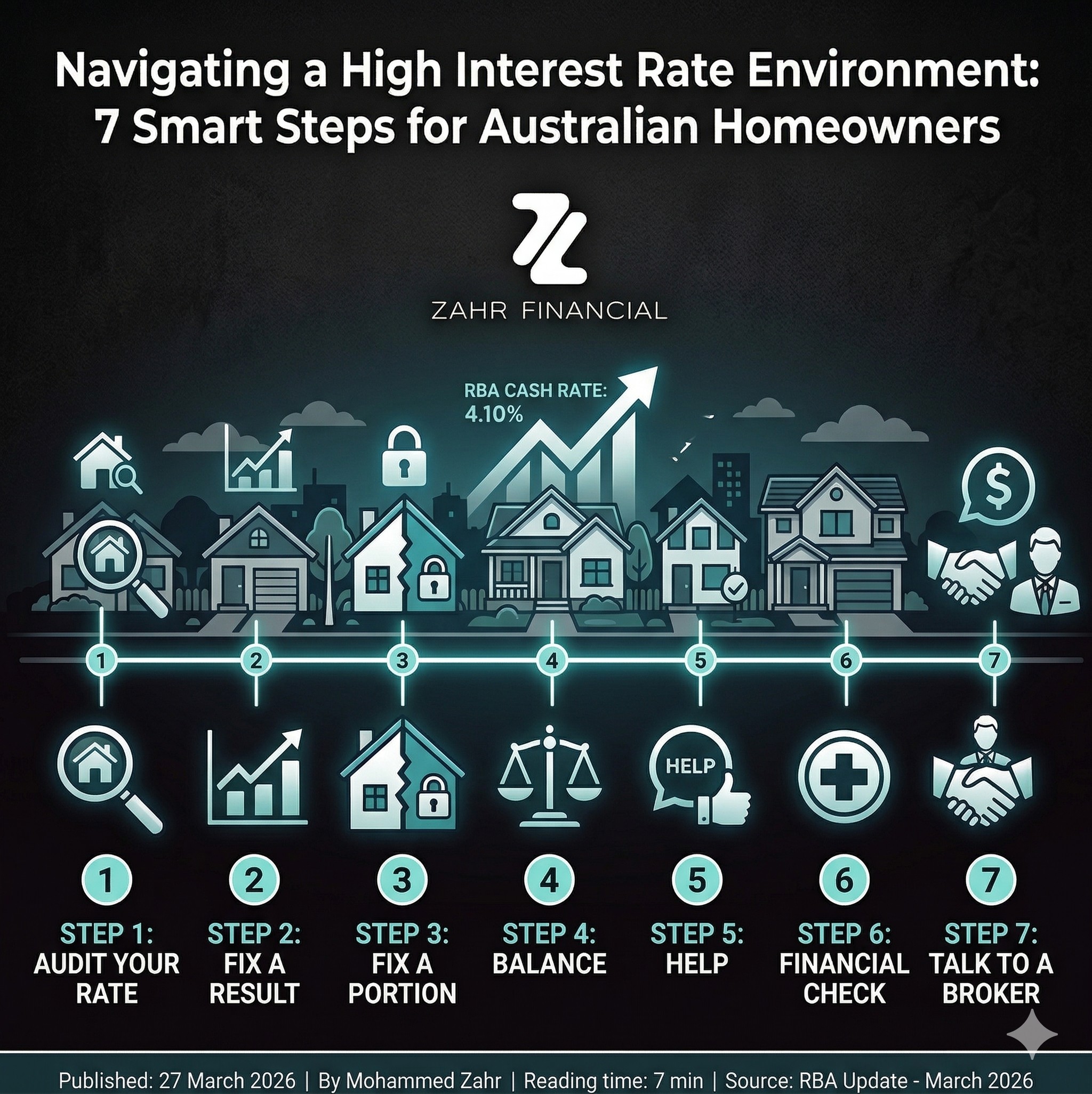
Navigating a High Interest Rate Environment: 7 Smart Steps for Australian Homeowners
Published: 27 March 2026 | By Mohammed Zahr | Reading time: 7 min
RBA Update — March 2026
On 18 March 2026, the Reserve Bank of Australia lifted the official cash rate by 25 basis points to 4.10% — the second consecutive hike in 2026, following February's increase from 3.60% to 3.85%. Governor Michele Bullock has confirmed every board meeting remains "live," meaning further hikes at the May meeting are still on the table. Source: RBA.gov.au
Australian borrowers have had a turbulent few years. After enjoying historically low rates post-pandemic, we saw aggressive tightening, a brief easing cycle through 2025 — and now rates are climbing again. Renewed inflation (currently 3.8% year-on-year, well above the RBA's 2–3% target band), a tight labour market, and global supply pressures have forced the RBA's hand. If you have a mortgage or are planning to buy, you need a clear strategy. Here's exactly what to do.
Current Rate Snapshot
- RBA Cash Rate (March 2026): 4.10%
- Headline CPI (January 2026): 3.8% year-on-year
- RBA Target Inflation Band: 2–3%
Step 1: Audit Your Current Mortgage Rate Immediately
The first thing every borrower must do is find out exactly what rate they're on right now. With the cash rate at 4.10%, many lenders have passed on the full increases — but not all uniformly. Some borrowers on older loans are paying a loyalty tax of 0.5–1.0% above what new customers are being offered.
Log into your lender's portal or call your bank and ask: "What is my current interest rate, and what rate would a new customer receive on the same loan today?" That gap is money you may be leaving on the table every single month.
💡 Broker Tip: Even a 0.40% reduction on a $600,000 loan saves you roughly $2,400 per year. Over five years, that's a significant return for a single phone call — or a chat with us.
Step 2: Explore Refinancing — But Do It Strategically
Refinancing is one of the most powerful tools available in a high-rate environment — but it must be approached carefully. The key question isn't just "can I get a lower rate?" It's "does the total cost of switching — including break fees, valuation costs, and establishment fees — make financial sense over my intended loan term?"
In the current environment, lenders are actively competing for quality borrowers. Cash-back offers, fee waivers, and discounted rates are available for refinancers with strong equity and clean credit histories. At Zahr Financial, we compare hundreds of products across the market to find the right fit — not just the flashiest headline rate.
💡 Important: With the RBA flagging potential further hikes at May's board meeting, don't wait for the "perfect" time to refinance. Your borrowing capacity may reduce further if rates rise again.
Step 3: Weigh Up Fixing Part or All of Your Rate
The fixed vs. variable debate is never simple, and it's especially complex right now. With the RBA board split five-four in March 2026 and the rate outlook genuinely uncertain, markets expect at least one further hike — potentially taking the cash rate to 4.35% by mid-year.
A split loan strategy — fixing a portion (say 50–70%) while keeping the remainder variable — offers both rate certainty and the flexibility to make extra repayments. 2-year fixed rates are currently sitting around 5.4–5.9% depending on the lender and your LVR.
💡 Our View: Given the RBA's data-dependent approach, a split loan structure makes sense for most borrowers right now. Book a call with Mohammed to work out the right structure for your situation.
Step 4: Build a Buffer — Or Tap the One You Have
Every dollar sitting in an offset account reduces the interest charged on your loan — effectively giving you a guaranteed, tax-free return equal to your mortgage rate. With rates in the 6–7% range for many borrowers, having $20,000 in an offset saves roughly $1,200–$1,400 per year in interest — far better than a savings account or term deposit.
If you've already built a buffer through extra repayments, review whether redrawing some funds makes more sense than leaning on high-rate credit cards or personal loans.
Step 5: Know Your Rights Around Mortgage Hardship
Many Australian households are feeling the squeeze from rising repayments and living costs simultaneously. What many borrowers don't realise is that lenders are legally required under the National Consumer Credit Protection Act to consider genuine hardship applications.
If you're struggling, you can apply for a temporary repayment pause, a switch to interest-only repayments, or a loan term extension. These options won't remove the debt, but they can provide critical short-term breathing room. Applying for hardship assistance does not automatically affect your credit file.
💡 Free Help: The National Debt Helpline (1800 007 007) offers free, confidential financial counselling. You can also call us on 1300 755 094 — we're happy to talk through your options.
Step 6: First Home Buyers — Opportunity Still Exists
Higher interest rates have cooled property price growth in some markets, creating genuine opportunity for first-home buyers with a saved deposit. While borrowing capacity is lower than two years ago, there is less competition and more room to negotiate on purchase price.
Government assistance remains meaningful: the First Home Guarantee (5% deposit, no LMI), state-based stamp duty concessions, and the First Home Super Saver Scheme can significantly reduce your upfront costs. At Zahr Financial, we specialise in helping first home buyers navigate these schemes.
💡 Action Step: Get your pre-approval sorted now and stress-test your budget at 6.5–7% to confirm you can manage repayments if further hikes arrive.
Step 7: Talk to a Mortgage Broker — Not Just Your Bank
Your bank has one product suite. Zahr Financial has access to 30+ lenders — including major banks, regional banks, credit unions, and non-bank lenders — and can compare hundreds of loan products to find the right structure for your situation.
Crucially, mortgage brokers in Australia are bound by a best interests duty under law — meaning we're legally required to recommend a loan in your best interest. And in most cases, our service is provided at no cost to you, as brokers are paid by lenders upon settlement.
According to the MFAA, mortgage brokers now write more than 70% of all new home loans in Australia — because borrowers have recognised the value of expert, lender-agnostic advice, especially in complex rate environments like this one.
Frequently Asked Questions
What is the current RBA cash rate in Australia? As of March 2026, the RBA cash rate is 4.10%, following two consecutive 25-basis-point hikes in February and March 2026. Further increases remain possible at the May 2026 board meeting.
Will interest rates go up again in 2026? The RBA is taking a data-dependent approach and every board meeting is "live." Major banks are forecasting at least one further hike, potentially taking the cash rate to 4.35% by mid-year, depending on Q1 CPI data due in late April.
Should I fix my home loan in 2026? It depends on your circumstances and risk tolerance. Many brokers recommend a split loan structure in the current environment — fixing a portion for certainty while keeping the rest variable. Speak with Mohammed at Zahr Financial for personalised advice.
How does the RBA cash rate affect my repayments? On a $600,000 loan, each 0.25% rate rise adds approximately $83 per month. The two 2026 hikes combined add roughly $166/month compared to end-2025.
Can Zahr Financial help me refinance if I'm under pressure? Yes — we compare products across 30+ lenders at no cost to you. Call us on 1300 755 094 or book an appointment online.
This article provides general information only and does not constitute financial advice. Please seek professional advice suited to your individual circumstances. ZAHER, MOHAMMED ABN: 28 761 343 294. Credit Representative #546129 authorised under Australian Credit Licence #546129.


